
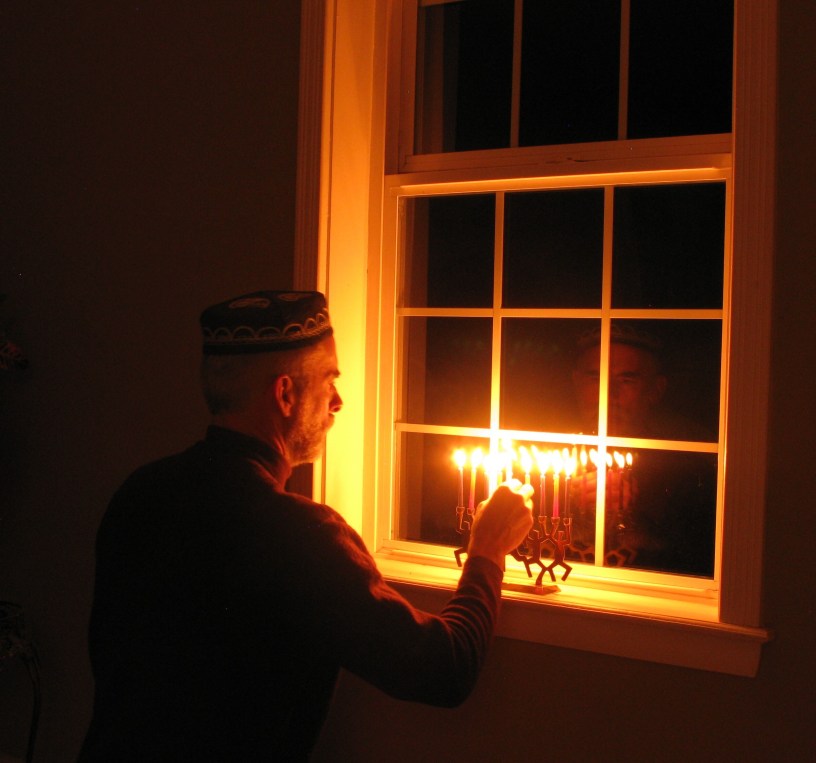
This evening begins Chanukah. This article was originally published on the Holy Disciples of Yehoshua website at hdyf.org.
Chanukah calls to mind the nine-stemmed candlestick or chanukkiah. The spinning dreidel and tasty latkes are also among the more familiar items associated with the celebration.
As with any holiday, there are ample lore and legend. What do we encounter when we look beyond the festivities to its origin two millennia ago?
First, Chanukah means dedication. It commemorates the dedication, or rather, rededication of the temple at Jerusalem by the Maccabees. It was actually at least the fifth dedication. The first was the dedication of the mishkan (a mobile temple) in the wilderness. The second was the dedication of Sh’lomo’s (Solomon’s) temple. The third was the rededication of that temple by Yoshiyahu after it had been desecrated by his father, Menasheh. The fourth was the dedication of the second temple under Ezra and Nechemyah (Nehemiah).
The mishkan was a modular temple which could be disassembled and reassembled as the nation traveled from Egypt to the Promised Land. In fact, its use continued long after they reached their destination.
Well after Israel took possession of her inheritance, King Sh’lomo was granted the privilege of erecting the first fixed temple at Jerusalem–a magnificent wonder of the ancient world. This temple was completed in the month of Adar and was dedicated during the Passover season amidst great rejoicing.
Regrettably, as all humanity is inclined to do, Israel squandered her inheritance. Years after the northern tribes of Israel were attacked, plundered and deported to faraway lands by the Assyrians, Judea too was invaded by the Babylonians as a direct result of her apostasy. The unthinkable–the destruction of the glorious temple ensued and a seventy-year lapse in temple worship followed.
However, while the northern tribes were dispersed into obscurity, God permitted a remnant of the Jews, made up primarily of Y’hudah, Levi and Benyamin, to return to the Holy Land. After many years of interrupted labor, a second temple, not so glorious as the first, was built. It was dedicated during the season of Sukkot, again with much festivities.
Even at the onset of construction, the oldest among the returnees wept to see how inferior this second temple was to the first (Ezra 3:12). Yet, in response, they were assured of the following:
Who is left among you who saw this house in her former glory? And how do you see it now? When compared to it, is it not as nothing in your eyes? Yet now be strong . . . For so says YHVH of Hosts: “Yet once, it is a little while, and I will shake the heavens and the earth and the sea and the dry land. And I will shake all the nations; and the desire of all nations shall come. And I will fill this house with glory,” says YHVH of Hosts . . . “The glory of this latter house shall be greater than that of the former,” says YHVH of Hosts. “And in this place I will give peace, says YHVH of Hosts.”
Chaggai (Haggai) 2:3-4,9
Given how pathetically this temple compared with Sh’lomo’s as a physical edifice, we do well to ask, just how did its glory exceed the former?
Some claim that the glory was in Herod “the Great’s” stupendous enhancements to the second temple, lending it enough grandeur to impress the Romans as well as inflate his personal pride and that of the populous. Yet Herod’s enlargement, while exceeding Sh’lomo’s in size, hardly matched it in exquisite finery. Neither was such superficiality as an Idumean’s monument to himself of the least interest to a prophet such as Chaggai. The glory was not it its mass or architecture but what occupied it. But leaving that distraction . . .
Despite having a national memory of periodic religious golden periods, subsequent declines and the tremendous upheavals that followed those declines, enthusiasm for the way of YHVH waned again over time amongst a large portion of the population.
It was in the second temple period that a new king arose whose conquests would alter the world–Alexander the Great.
Compared with earlier emperors whose realms had enveloped the holy land, Alexander was kind to the Jews. He permitted them to continue their temple worship and customs. Nonetheless, he was eager to spread Greek culture wherever he went. A significant number of Jews truly admired the art, language and rationalism of Greece. Others merely saw embracing Hellenism as a method for securing empire-sanctioned influence on the local scene.
Gradually, the influence of the Hellenistic Jews increased, both in terms of their numbers among the populace and their political power. Greek fashions, polytheism, systematic materialistic rationalism, athletic events in the nude, abandonment of brit milah (circumcision) all manifested radical departures from the way of YHVH.
When Alexander died prematurely, his empire was divided among his preeminent generals, Antigonus, Cassander, Lysimachus, Ptolemy and, later, Seleucus. Initially within the realm of the relatively tolerant Ptolemies of Egypt, the Holy Land found itself an object of Seleucid advances from Syria. Seleucid king Antiochus III wrested Judea from the Ptolemies in 198 BCE.
His son, Antiochus Epiphanes, inherited a fervor for things Greek from his progenitors. However, he did not inherit Alexander’s tolerance. He saw Hellenistic ways as an indispensable catalyst to bind and solidify his empire. Anyone who did not adopt Greek culture was not only a blemish, but a weakness in his empire. Such a condition, particularly in a frontier province such as Judea was, to him, increasingly intolerable.
On his return from a bruising confrontation with Ptolemy on his Egyptian front, he determined to purge Judea of its monotheistic holdouts. On the 25th of Chislev 167 BCE, Antiochus IV Epiphanes fulfilled the words of the prophet Daniel when he desecrated the temple. There he removed the holy vessels, entered the Most Holy Place and sacrificed swine on the altar, dedicating the temple to Zeus.
In addition, he sent delegates to the villages throughout the land to compel Greek cultic practices in kind on a community level. Hellenism had become not a matter of inclination, but of life and death.
We would be remiss not to call attention to the intramural intrigue of this international shift; that is to say, what was occurring within Judaism, and not only within Judaism in general, but within its most influential family at the time, that of the high priesthood.
During the reign of Seleucus Philopator, Chonia (Onias) ben Shimon (2), remembered for his righteousness, served as high priest in Yerushalayim. During the first year after Antiochus IV succeeded Philopator, a Hellenized temple official encouraged the new emperor to plunder the temple. The resultant attempt failed, embittering Antiochus against Chonia, whom his government summoned to Antioch to face charges raised by the Hellenists.
Chonia had a brother, Yehoshua, who had Hellenized his name to “Jason.” Jason ingratiated himself to Antiochus with large sums of money, securing for himself the high priesthood and various secular political powers. So the transition from Hellenism as an optional lifestyle and value system to a coerced one occurred, not merely under foreign pressure, but from fellow Jews. It became, quite literally, a conflict between brothers at its epicenter.
It was in the village of Modin that a single patriarch touched off a spark that would portend great changes, not only for little Judea, but, ultimately, for the entire world.
There, an elder named Matityahu (Mattathias), was approached by an Antiochid delegate, who requested that he perform a pagan cultic rite before his village. When Matityahu refused, one of the other villagers stepped forward in his place. Overcome with indignation, Matityahu killed both the villager and the delegate, then fled into the hills with his five sons, Y’hudah, Yonatan, Shimon, Yochanan and El’azar.
Known as the Maccabees or Hasmoneans, they were joined by others who shared their desire to preserve the way of YHVH. They lived as refugees in their own land, inhabiting ravines and caves, locked in a game of cat-and-mouse with Antiochus’ forces. Initially, the Maccabees encounters with the Syrians were resounding defeats, for Antiochus had a pension for attacking them on Shabbat. With time, however, they gained success through persistent guerilla tactics and, more importantly, by the will of God.
When Matityahu died, his son Y’hudah took the lead on their military maneuvers. On the 25th of Chislev, 164 BCE, three years to the day from the Abomination of Desolation, Y’hudah regained control of the temple and its environs and began the eight day process of rededicating it. It is this dedication we commemorate when we observe Chanukah.
That is not the end of the story however, and it is here that we must distinguish between fact and folklore.
Based on the Gemarah (commentary on the oral law in Talmud) and other later writings, it is popularly taught that Chanukah is celebrated for eight days that we might remember a particular miracle. It is said that, when Judah rededicated the temple, there was enough sanctified oil for the temple menorah for but a day, yet the flames burned bright for eight days, giving time for the preparation of a steady supply of holy oil. However, our most reliable, ancient sources, the Jewish historian Josephus and the first and second books of Maccabees, make no mention of such a miracle. Neither do the other most ancient writings.[iii] Surely, as the rabbis have done for the last two millennia, the earlier writers would have made much of such a divine manifestation. Their silence demonstrates the tradition was fabricated at a later date.
So why eight days? The second Book of Maccabees tells us, “And they kept eight days with gladness, as in the feast of the Sukkot, when as they wandered in the mountains and dens like beasts. Therefore they bare branches, and fair boughs, and palms also, and sang psalms unto him that had given them good success in cleansing his place. They ordained also by a common statute and decree, that every year those days should be kept of the whole nation of the Jews.” (2 Maccabees 9:6-8)
Anciently, it was common to refer to Chanukah as the Second Sukkot or Feast of Tabernacles. Traces of Sukkot rituals such as the reciting of the entire Hallel psalms are present in Chanukah. Even today’s popular name, Festival of Lights, harkens to the fall Feast, for in Talmud (Sukkah 5:2-3) we read, “There were golden candlesticks there with four golden bowls on the top of them and four ladders to each candlestick, and four youths of the priestly stock and in their hands jars of oil holding a hundred and twenty logs which they poured into all the bowls. They made wicks from the worn out drawers and girdles of the priests and with them they set the candlesticks alight, and there was not a courtyard in Jerusalem that did not reflect the light of the Beth ha-She’uvah.” (See also Josephus Antiquities 12.7.7)
When hopes that they could regain and dedicate the temple in time for Sukkot went unrealized, it was natural to celebrate the event in the manner denied them at the last festival. Chanukah, after all, was instituted, not by God, but by men, a freewill gesture akin to the American Thanksgiving. Its traditions such as latkes, dreidel games and so on are, therefore, not sacred as are those of Passover or Sukkot.
Ironically, those of us who accept the New Testament Messiah have, of all peoples, the most to rejoice about at Chanukah.
The period from when the Maccabean revolt began to the rededication of the temple commemorated by Chanukah was three years. However, the rebellion would last another twenty-two years before the Jews would gain independence. Eventually, all five brothers of the initial revolt, Y’hudah, Yonatan, Shimon, Yochanan and El’azar, died violent deaths. And when peace came, it would be bittersweet.
As it turned out, the priesthood that came to occupy the temple offices was corrupt and not viewed by many as legitimate heirs. Positions, in fact, were bought and sold. Intrigue escalated to the point where members of the Hasmonean family were murdering one another.
As for foreign domination, that too was placed on the bargaining table—yet again.
It was hard to dwell in the Mediterranean at that time and not take notice of the Romans. Their successes in Spain and Gaul, as well as on their eastern frontiers, were well known to the Jews. It was the Romans who had drawn a line in the sand around Antiochus on one of his Egyptian forays. Sometime after Y’hudah’s death in battle, his brother, Yonatan, succeeded him. In the face of ongoing hostilities with Syria, he made a treaty with Rome.
After succeeding his brother Yonatan, Shimon and two of his sons were murdered by one of his sons-in-law. A surviving son, Yochanan (John Hyrcanus), was, in turn, succeeded by squabbling sons Y’hudah (a.k.a Aristobulus) and Yonatan (a.k.a. Alexander Jannaeus). Jannaeus had eight hundred fellow Jews–Pharisees–crucified at a victory banquet. The once heroic Hasmoneans had degenerated into a dynasty of corruption and treachery.
In 63 BCE, brothers Aristobulus II and Hyrcanus II were locked in civil war. Both appealed to Rome for assistance against the other. Pompeii offered to arbitrate, but arrived with enough forces to slaughter Aristobulus’ followers and to subjugate Judea indefinitely.
So where is the joy in Chanukah? Where is the joy in a dedication followed by two more decades of bloodshed? Where is the joy in the resultant ascendancy of a corrupt priesthood? Where is the joy in a short-lived temple community? Such questions are seldom asked today.
The Chanukah holiday is nowhere mentioned directly in the Tanakh (Old Testament), but it is, curiously, found in the New Testament, for it is there we find fulfillment of Chaggai’s prophesy. These scriptures, also arising from the Jewish community, record Yehoshua’s presence at the temple on Chanukah:
It was then Chanukah in Jerusalem; it was winter and Yehoshua was walking in the temple, in Sh’lomo’s Porch.
Then the Jews encircled him, and said to him, “Until when do you lift up our soul? If you are the Mashiach (Messiah), tell us publicly.” Yehoshua answered them, “I told you, and you did not believe. The works which I do in the name of my Father, these bear witness about me. Yet you do not believe, for you are not of my sheep, as I said to you.
My sheep hear my voice, and I know them, and they follow me. And I give eternal life to them, and they shall not perish to the age, never! And not anyone shall pluck them out of my hand.
My Father who has given them to me is greater than all, and no one is able to pluck out of my Father’s hand. I and the Father are one!”
Then again the Jews took up stones, that they might stone him.
Yehoshua answered them, “I showed you many good works from my Father. For which work of them do you stone me?”
The Jews answered him, saying, “We do not stone you concerning a good work, but concerning blasphemy, and because you, being a man, make yourself God.”
Yehoshua answered them, “Has it not been written in your Torah, ‘I said, you are gods’? If he called those gods with whom the word of God was, and the scripture cannot be broken, do you say of him whom the Father sanctified and sent into the world, ‘You blaspheme,’ because I said, ‘I am son of God?’
If I do not do the works of my Father, do not believe me. But if I do, even if you do not believe me, believe the works, that you may perceive and may believe that the Father is in me, and I in him.”
Then again they sought to seize him. And he went forth from their hand.
Yochanan (John) 10:22-39
Though apostasy in the Jewish community necessitated rededication in the first place, the sacrifice of the Maccabees and the victory given them set the stage for Yehoshua’s entry into a functional temple community. God could have chosen any people, any time and any place to bring Messiah into the world. So that he might fulfil the Torah and stand in our stead for our sins, he came to Judea, as a Jew, to a functioning temple community.
When he debated as a child with the temple sages, when he overturned the money-changers’ tables, when the veil between the holy and most holy place was ripped apart at the moment of his death–all this was more than mere symbolism. In every detail, it was critical for him to fulfill the ancient prophecies.
The mention in John 10:22 of Yehoshua being at the Temple in Yerushalayim during Chanukah is, of course, so brief, it nearly goes without notice. Of course, it hardly helps that anti-Semitic gentile translators nearly universally hide what the holiday is by rendering it with the opaque “Dedication” rather than the more familiar “Chanukah.” (That might have been justifiable in 1611, but hardly so from the 20th century on.)
What adds yet more interest is the fact that Yehoshua was a resident of Natzaret, not Yerushalayim (which is why he and his disciples were known as “Galilim”). Natzaret is 30 hours of walking (one-way) to Yerushalayim. Thus, even though several of the most crucial events of his life occurred there, Yehoshua did not frequent the Temple except when several-day excursions to Yerushalayim afforded it. Such trips were, of course, commanded for the Shalosh Regalim when the weather is far more salubrious. Around Chanukah, the weather tends to be chilly and wet, neither is there any other general occasion juxtaposed to warrant such prolonged exposure to the elements.
This obviously doesn’t mean Yehoshua was visiting Yerushalayim solely for Chanukah. He could have simply been visiting family–but, again, winter is a lousy time for such travel. So the fact Yehoshua was in Yerushalayim’s environs at all this time of year is so much the more noteworthy. It was fitting that he should pay his respects to those who sacrificed so much, and to his Father for ensuring, through them, that the whole social and religious context in which he needed to work was in place.
It is truly amazing what is packed into that one verse—John 10:22—and it is outrageous how translators have obscured it, as they have much else in the New Testament.
Disciples rejoice that God masterminded this shortest-lived temple revival specifically to set the stage for Messiah’s first coming. Yet, we do so with a certain measure of sobriety. A mere forty years after Yehoshua’s execution, the temple and its community came to a violent end. In 70 CE, the Roman general, Titus Flavius Vespasianus, took the temple after a siege of Jerusalem and burned and leveled it. Curiously, it is said that this kindling occurred on the anniversary of the same fate of Sh’lomo’s temple at the hands of Nevuchadnetzar–the ninth of Av, which remains to this day, a fast day for our people as referenced in the book of Zecharyah (Zechariah 8:19).
Also on the somber side, Chanukkah is, as noted earlier, the anniversary of Antiochus Epiphanes’ Abomination of Desolation, as well as of the subsequent rededication of the temple. In twisted irony, the heirs of the Maccabeans, whose valiant exploits were so instrumental in expelling Antiochus, set the stage for Roman conquest of the Holy Land and, ultimately, the destruction of the Second Temple and Jerusalem.
In this light, we are reminded of Yehoshua’s reference to the Abomination as a future event. [Matityahu (Matthew) 24:15, Mark 13:14; Luke 21.20-21] Given the conditions he describes and the statement that his generation would not pass before their occurrence, the reference to 70 CE is clear. However, the repetition of fulfillments so characteristic of Biblical predictions leaves the distinct impression of events in our future as well.
Before closing, we note the curious timing of Chaggai’s revelation of the temple’s future glory–the twenty-first day of the seventh month, which is the last day of the fall feast of Sukkot. The indications are several and strong that Yehoshua was born during one of the fall holy days. It is hardly coincidence, therefore, that Chaggai’s next revelation was received on the twenty-fourth of Chislev, the day before Chanukah begins:
Now set your heart from this day and forward, from the twenty-fourth day of the ninth month, from the day that Jehovah’s temple was established. Set your heart. Is the seed still in the barn? Yes, as yet the vine, and the fig tree, and the pomegranate, and the olive tree have not brought forth. From this day I will bless them.
And a second time the Word of Jehovah was to Chaggai, in the twenty-fourth of the month, saying, “Speak to Zerubbavel, the governor of Y’hudah, saying, ‘I will shake the heavens and the earth. And I will overturn the throne of the kingdoms, and I will destroy the strength of the kingdoms of the nations.’”
Chaggai 2:18-22
So Chanukah is relevant to us in several ways. It is fitting that we should commemorate that relatively ephemeral and bittersweet revival of the second temple, for within that brief interval, the Messiah pitched his sukkah (hut) with us, setting the supreme example, laying down his flawless life as the ultimate servant for all mankind.
Yehoshua told us, “You are the light of the world. A city situated on a mountain cannot be hidden. Nor do they light a lamp and put it under the grain measure, but on the menorah; and it shines for all those in the house. So let your light shine before men, so that they may see your good works, and may glorify your Father in heaven.” (Matityahu 5:14-16) To this comports well the much latter rabbinic instruction to place the Chanukah menorah or Chanukiah where it will give light in public.
On a Chanukah menorah, the shammash (servant) candleholder is higher than the others. This is an apt reminder of Yehoshua’s teaching, “You know that those seeming to rule the nations lord it over them, and their great ones exercise authority over them. However, it shall not be so among you, for whoever desires to become great among you shall be your servant. And whoever of you desires to become first, he shall be slave of all. For even the Son of Man did not come to be served, but to serve, and to give his life as a ransom for many. (Mark 10:42-45)
As we anticipate his long-awaited return, we are reminded that dedications of various sorts, including the dedication of ourselves (1 Corinthians 6:19-20)[v], must precede great events in God’s unfolding plan. We are apprised of some the conditions we will face in the interim and of our present responsibility to boldly serve as servants and lights in a dark world.
References
The reader is encouraged to read directly from the most ancient accounts from which this material is largely drawn, namely the following:
1 Maccabees
2 Maccabees
Josephus’ Antiquities, Book 12, Chapters 6 & 7
Shabbat 21b of the Gemara, set to writing between about 350 and 500 CE is the first extant mention of the alleged Chanukah oil miracle. The applicable section reads, “Our rabbis taught . . . For when the Greeks entered the Temple, they defiled all the oils therein, and when the Hasmonean dynasty prevailed against and defeated them, they made search and found only one cruse of oil which lay with the seal of the High Priest, but which contained sufficient for one day’s lighting only; yet a miracle was wrought therein and they lit [the lamp] therewith for eight days.” Though countless passages in both the Mishna (c. 200 CE) and the Gemara (which, together comprise the Talmud) customarily cite specific earlier authorities, sometimes reaching back to Hillel and Shammai (1st century BCE), this passage cites no sage in particular. It seems, the temple having been destroyed, a justification for the holiday retaining its joy had to be fabricated
Also problematic to the oil legend is the fact that everything in the temple service had to be consecrated prior to fitness for service. For example, in Sh’mot (Exodus 29:35-37), we read:
And so you shall do to Aharon and to his sons, according to all which I have commanded you; you shall consecrate them seven days. And you shall offer a bull of a sin offering daily for atonement; and you shall purify the altar in your making atonement for it; and you shall anoint it to sanctify it. You shall make atonement seven days for the altar, and shall sanctify it; and the altar shall become most holy, all touching the altar becomes holy.
The dedication of Sh’lomo’s temple followed this pattern, the “חנכת המזבח” (chanukat hamizbeach – dedication of the altar) requiring seven days (2 Chronicles 7:9) Given the desecration of the temple and the altar, there was no circumventing the seven-day cleansing period—and that would have imposed an adequate lag time for consecration of the oil as well.
In his Commentary on the Jewish New Testament, David H. Stern incorrectly attributes the legend of the oil to 2 Maccabees. However, it is nowhere to be found in that work, which gives the historical explanation quoted herein.
The account attributed to Yochanan (John) has so many occurrences of “the Jews” as to appear anti-Semitic. A non-Jew, however, should bear in mind that Yehoshua’s confrontations were entirely within Judaism—Jew to Jew—and he and his disciples did not exit Judaism, but remained Jewish. What the author of Yochanan was doing was distinguishing between the Jews of Judea, whom he referred to simply as “Jews,” and the Jews of the Galil, whom he and his contemporaries referred to as “Galilim” (Galileans). Yehoshua and his followers being of the latter group were also referred to as “Notzrim” (Nazarenes) as Natzret was his hometown. The more educated among the Judeans, including the P’rushim (Pharisees) tended to look condescendingly on the Galilim, whom they considered more rustic. Their respective accents gave them away to each other, and such dynamics could predispose some sass between them. The author of Yochanan, particularly astute to social nuances, was keen to illuminate the interplay between them.
Paul writes, “Or do you not know that your body is a sanctuary of the holy spirit in you, which you have from God, and you are not of yourselves? You were purchased at a cost. So glorify God in your body, and in your spirit, which are of God.” When he does so, he is drawing from Sh’mot (Exodus) 25:8 where Israel was told, “And let them make me a sanctuary, that I may dwell among them.” “בתוכם” (most often translated into English as “among them”) also and more literally means “inside them.” So there is a double entendre in that, indeed, the subject is the nation’s collective worship epicenter, but each person is also to make themselves a sanctuary in which God may dwell.
 Straight & Narrow